

The vacuum furnace stands as an indispensable core piece of equipment in the fields of modern materials heat treatment and advanced manufacturing, finding widespread application across high-end industrial sectors such as aerospace, nuclear energy, electronics, and powder metallurgy. Among the many components of a vacuum furnace, the "Hot Zone"—the complete structural system within the furnace chamber responsible for generating and maintaining the high-temperature environment—serves as the device's "heart"; its performance directly dictates the quality and efficiency of the heat treatment process.
In the construction of the vacuum furnace's Hot Zone, Molybdenum has emerged as the material of choice for manufacturing Hot Zone components, thanks to its exceptionally high melting point (2620°C), superior high-temperature strength, low vapor pressure, and excellent thermal and electrical conductivity. The following discussion will provide an in-depth analysis of the specific critical areas within the vacuum furnace's Hot Zone structure where molybdenum products are utilized.
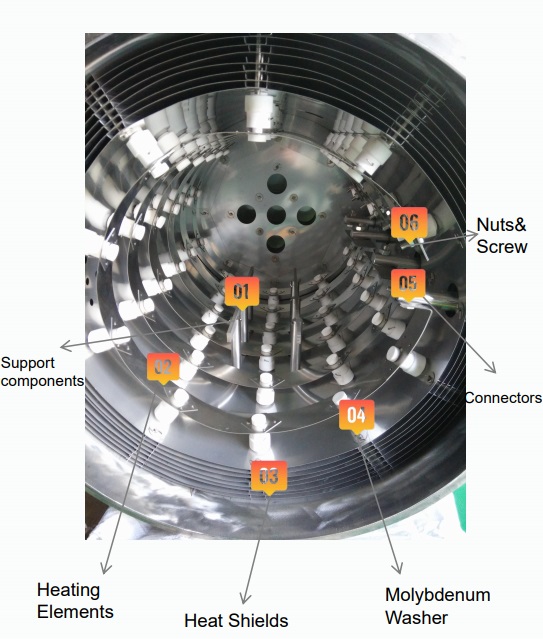
The Core of the Hot Zone: Why Molybdenum?
In high-temperature environments under vacuum or protective atmospheres (typically exceeding 1000°C), ordinary steels rapidly soften and fail due to oxidation; conversely, while ceramic materials possess high-temperature resistance, they suffer from poor thermal shock resistance and are difficult to process. Molybdenum and its alloys (such as Molybdenum-Lanthanum and TZM alloys) perfectly bridge this gap.
The application of molybdenum products in vacuum furnaces is primarily concentrated in structural components required to withstand extreme temperatures, high voltages, and high-vacuum environments. According to technical documentation from numerous vacuum equipment manufacturers and material suppliers, the application of molybdenum within the vacuum furnace's Hot Zone is predominantly manifested across the following "Four Major Systems."
I. Heating Element System: The "Generator" of Heat
Heating elements are the components within a vacuum furnace that directly convert electrical energy into thermal energy; this constitutes the most critical application scenario for molybdenum products.Molybdenum Wire and Strip: Within the temperature range of 1000°C to 1600°C, molybdenum heating elements represent the prevailing choice in the industrial sector. Depending on the specific furnace design, molybdenum is typically fabricated into either wires or strips. For large-scale industrial furnaces (such as vacuum molybdenum strip furnaces), molybdenum strips are generally preferred; their larger cross-sectional area enables them to withstand higher currents and power loads, while also rendering them less susceptible to deformation at high temperatures.
Molybdenum-Lanthanum Alloy: This represents an upgraded version of pure molybdenum. By incorporating trace amounts of lanthanum (La) into the molybdenum matrix, the resulting molybdenum-lanthanum alloy exhibits a higher recrystallization temperature and significantly enhanced high-temperature strength. In high-end vacuum furnaces, high-temperature molybdenum-lanthanum alloy strips serve as heating elements, offering a longer service life and superior resistance to deformation compared to pure molybdenum.
II. Thermal Shield System: The "Guardian" of Energy
To achieve high temperatures while maintaining energy efficiency within a vacuum furnace, the heating elements must be enveloped by multiple layers of thermal shields to prevent heat from dissipating outward. Since the furnace interior operates under a vacuum—precluding heat dissipation via convection and relying solely on radiation—metal shields with high reflectivity constitute the optimal choice.
Molybdenum Metal Shields: In the high-temperature zones directly facing the heating elements (specifically the innermost layer), the use of molybdenum plates or sheets is mandatory. Typically, thermal shields are fabricated from molybdenum plates ranging in thickness from 0.3 mm to 0.5 mm, formed into cylindrical or octagonal configurations. At elevated temperatures, these molybdenum shields not only maintain their structural integrity but also effectively reflect heat back toward the furnace core.
Composite Structures: A typical all-metal thermal shield assembly features a composite structure: an inner layer comprising multiple molybdenum shields (designed to withstand the highest temperatures), a middle layer potentially utilizing molybdenum-lanthanum alloy shields, and an outer layer consisting of stainless steel shields (positioned where temperatures have already subsided). This specific combination ensures robust high-temperature performance while simultaneously facilitating effective cost control. For instance, certain procurement specifications for vacuum furnaces explicitly mandate a thermal shield configuration consisting of "one layer of molybdenum-lanthanum alloy, two layers of molybdenum metal shields, and three layers of heat-resistant stainless steel." III. Structural Support and Fixturing Systems: Frameworks and "Trays"
Beyond heating and thermal insulation, the interior of a furnace requires a multitude of structural components to support the heating elements, secure the thermal insulation screens, and bear the weight of the workpieces undergoing processing.
Molybdenum Supports and Fasteners: Heating elements cannot come into direct contact with the metal walls of the furnace; instead, they must be supported by insulating ceramics (such as alumina components). Furthermore, the rods, nuts, and washers used to connect these ceramic components to the furnace shell—as well as those used to secure the molybdenum screens—typically must also be fabricated from molybdenum. This is because other metals tend to react with ceramics or soften at high temperatures, whereas molybdenum fasteners retain their structural rigidity even at temperatures reaching 1450°C.
Molybdenum Trays and Racks: During the heat treatment process, workpieces cannot be placed directly on the furnace floor; they must instead be positioned on supporting racks. The trays, racks, and baskets used to hold the parts undergoing treatment—such as cemented carbides, superalloys, and titanium alloys—must exhibit excellent creep resistance at high temperatures. Molybdenum racks are the standard choice for operating conditions ranging from 1200°C to 1600°C.
IV. Electrodes and Connectors: The "Conductors" of Energy
The transfer of energy from the transformer located outside the furnace body to the internal molybdenum heating elements requires a critical interface: the electrode.
Molybdenum Electrodes: Typically, the electrode assembly consists of a water-cooled copper electrode passing through the furnace shell; however, on the interior side—where it connects to the heating elements—the contact point must be constructed from a high-temperature-resistant material. Common designs utilize solid molybdenum electrode rods or molybdenum collets. The use of molybdenum ensures that, even when conducting high currents, the electrode does not overheat or melt due to contact resistance.
Molybdenum Connection Straps: In large-scale heating chambers, to facilitate assembly, direct welding is often avoided in favor of using flexible, laminated molybdenum straps to connect the electrodes to the heating elements. This design serves to absorb the mechanical stresses generated by thermal expansion, thereby preventing rigid connections from fracturing.
In summary, the hot-zone structure of a high-performance vacuum furnace constitutes virtually a "world of molybdenum." From the electrically energized molybdenum heating strips that glow with heat, to the molybdenum thermal screens that provide insulation, and extending to the molybdenum screws that secure the structure and the molybdenum trays that support the workpieces—molybdenum products permeate every corner of the vacuum furnace's hot zone. If you are in the process of purchasing or maintaining a vacuum furnace, understanding the applications of these molybdenum components is crucial. High-quality molybdenum products—such as molybdenum sheets and rods featuring high purity (exceeding 99.95%) and high processing precision—directly determine the vacuum furnace's maximum operating temperature, temperature uniformity, maintenance frequency, and overall service life. Selecting a supplier of molybdenum materials that have undergone rigorous quality certification is a key step in ensuring the long-term, stable operation of your vacuum furnace.
Post time:Sep-25-2020


