

How to Choose Molybdenum Threaded Rods for High-Temperature Applications
In high-temperature industrial environments, selecting the right fastening solution is critical for both safety and performance. Molybdenum threaded rods have become a preferred choice in industries such as glass melting, vacuum furnaces, and aerospace due to their excellent high-temperature strength and stability.
However, improper selection or usage can lead to deformation, oxidation, or premature failure. This guide explains how to choose the right molybdenum threaded rods and how to extend their service life.
1. Why Use Molybdenum Threaded Rods?
Compared to conventional steel fasteners, molybdenum rods and threaded rods offer:
- Excellent high-temperature resistance (up to 1800°C in vacuum)
- Low thermal expansion coefficient
- High melting point (2620°C)
- Good creep resistance under load
These properties make them ideal for:
- Vacuum furnace components
- Glass melting furnaces
- Semiconductor equipment
- Heat shields and fixtures
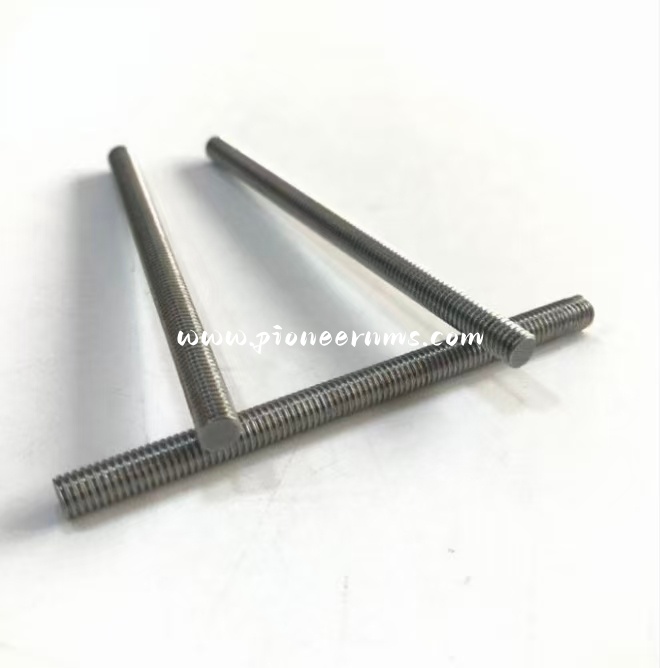
2. Key Factor #1: Temperature vs Load Capacity
The most critical factor when selecting molybdenum threaded rods is the relationship between temperature and mechanical load.
At elevated temperatures:
- Strength decreases
- Creep deformation increases
Practical guideline:
- Below 1000°C → standard molybdenum rods perform well
- 1000–1400°C → consider larger diameter or reduced load
- Above 1400°C → recommend TZM threaded rods for improved strength
This is similar to current density control in electrodes:
Higher stress + higher temperature = faster failure
3. Key Factor #2: Diameter Selection (Very Important)
Just like electrode design, rod diameter directly affects service life.
- Smaller diameter → higher stress → shorter lifespan
- Larger diameter → better load distribution → longer lifespan
Engineering recommendation:
- Light-duty applications → M6–M12
- Medium load → M12–M20
- Heavy-duty / high-temp → M20+ or custom size
If deformation or bending occurs, increasing diameter is often the most effective solution.
4. Key Factor #3: Oxidation Environment
Molybdenum performs exceptionally well in:
- Vacuum
- Inert gas (argon, nitrogen)
However, in oxidizing environments (air at high temperature):
- Oxidation starts around 400–600°C
- Rapid material loss may occur
Solutions:
- Use protective atmosphere
- Apply coatings
- Reduce exposure time
5. TZM Threaded Rods vs Pure Molybdenum
For demanding applications, TZM (Titanium-Zirconium-Molybdenum alloy) threaded rods provide clear advantages:
- Higher recrystallization temperature
- Better creep resistance
- Improved mechanical strength at high temperature
When to choose TZM:
- Long-term operation above 1200°C
- High-load structural applications
- Critical furnace components
6. Common Failure Problems & Solutions
Problem 1: Rod bending or deformation
✔ Cause: High temperature + insufficient diameter
✔ Solution: Increase diameter or switch to TZM
Problem 2: Thread damage or wear
✔ Cause: Thermal expansion or repeated assembly
✔ Solution: Improve machining precision or use coated threads
Problem 3: Oxidation and material loss
✔ Cause: Exposure to oxygen at high temperature
✔ Solution: Use vacuum/inert atmosphere
7. How to Extend Service Life
To maximize the lifespan of molybdenum threaded rods, consider:
- Optimize rod diameter and load distribution
- Avoid excessive stress concentration
- Use protective atmosphere when possible
- Select TZM material for high-temperature conditions
- Ensure proper installation and alignment
8. Applications of Molybdenum Threaded Rods
Molybdenum threaded rods are widely used in:
- Glass furnace electrode fixing systems
- Vacuum furnace hot zones
- Semiconductor processing equipment
- High-temperature structural assemblies
As industrial processes demand higher temperatures and precision, the role of molybdenum fasteners continues to grow.
9. Conclusion & Technical Support
Choosing the right molybdenum threaded rod is not just about size — it involves temperature, load, environment, and material selection.
If you are currently facing issues such as:
- Fast deformation
- Short service life
- Unstable high-temperature performance
we can help.
We offer:
- Custom-sized molybdenum threaded rods
- TZM threaded rods for high-performance applications
- Technical support based on your working conditions
Feel free to contact us for latest pricing, drawings, or application recommendations.
Post time:Sep-25-2020


