

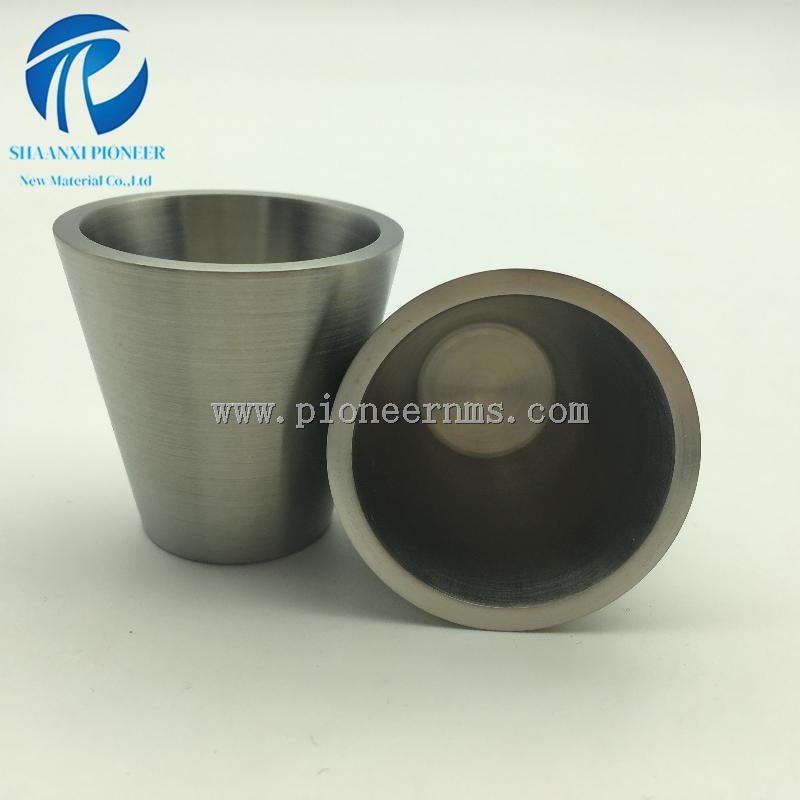
Sapphire crystal is widely used in LEDs, optics, and semiconductors, produced mainly through the Kyropoulos (KY) and Czochralski (CZ) growth methods. Both rely on molybdenum crucibles, which act as the high-temperature container for melting alumina.
The process begins by loading high-purity alumina (Al₂O₃) powder into a molybdenum crucible placed inside the sapphire growth furnace. The system is filled with argon gas or vacuum-sealed to prevent oxidation. The crucible is then heated to about 2050°C, melting the alumina evenly thanks to molybdenum’s excellent thermal conductivity and stability.
In the Czochralski method, the seed is slowly pulled upward while rotating, allowing the crystal to grow from the molten alumina.
In the Kyropoulos method, the seed remains fixed, and the crystal grows gradually inside the crucible during controlled cooling.
Throughout the process, the molybdenum crucible maintains uniform heat distribution, resists deformation, and prevents contamination—critical factors for achieving crack-free, high-purity sapphire ingots.
With a melting point of 2610°C and superior chemical resistance, molybdenum outperforms materials like quartz or platinum.
Our 99.95% high-purity molybdenum crucibles, available in flat, round, or flanged designs, are engineered for durability and precision, ensuring consistent sapphire crystal growth and long service life in modern KY and CZ furnaces.
Post time:Sep-25-2020


